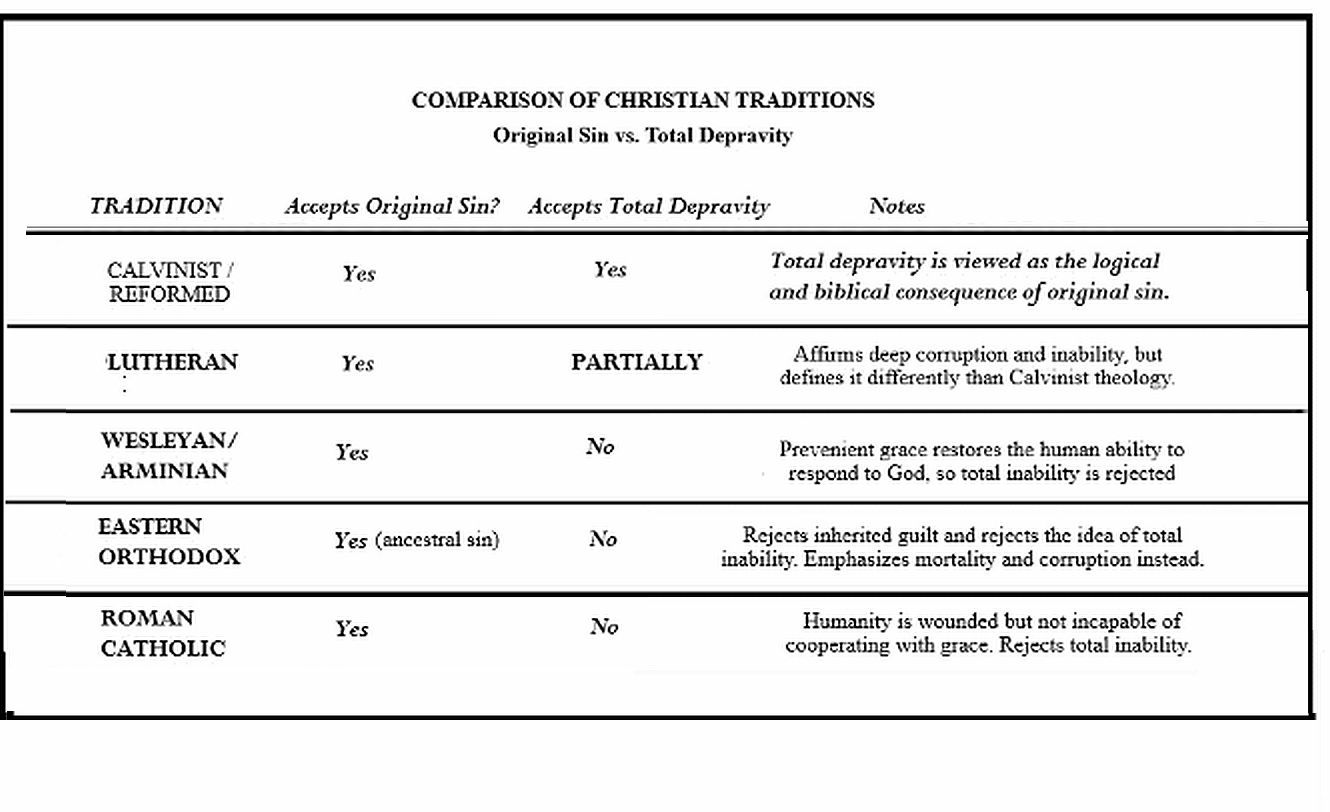
The teaching of “total depravity” affirms that humans have inherited the guilt of original sin from the first man and woman. Total depravity teaches:
• Every part of human nature is affected by sin (mind, will, emotions, desires).
• Humans are spiritually unable to choose God or do true good without regenerating grace from God.
A certain commentary says, “It was not David's sins that entitled him to be called 'A Man After God's Own Heart,' but 'his confession, his repentance, and his prayers' that entitled such a label.” Psalm 51:1-9 is David's prayer for forgiveness for his particular sin with Bathsheba and her husband.
He describes his sin as “transgression” (v. 1, 3), “iniquity” (v. 2, 5, 9), “evil” (v. 4), and “sin” (v. 2-5; 9). “Sin” means “missing the mark”; “transgression” means “breaking God's law”, and “iniquity” means “wickedness.” “Sin” can be summarized as “any violation of the will of God.” David calls what he had done as personally done; that is, it is “my” sin (v. 1),“my” iniquity (v. 2), “my” transgression and “my” sin (v. 3). He says “I sinned” (v. 4) and “my” sin (v. 9). He really does not seek to “pass the buck.”
David begs God to have mercy specifically upon him (himself, v. 1), to blot out his transgressions (v. 1, 9), wash his iniquity (v.2, 7), cleanse his sin (v. 2), purify him with hyssop (v. 7), and hide God's face from his sin (v. 9).
The verse "In sin did my mother conceive me" is the basis from which the doctrine of "Original Sin" apparently was constructed, a doctrine which Jesus Christ flatly contradicted, saying, "Suffer the little children to come unto me, for unto such belongs the kingdom of God" (Mark 10:14).
WHAT IS SIN?
David is saying that his mother was a sinner when he was conceived and when he was born, the world was full of sin. Sin and sinful people had surrounded him his whole life. Sin is Biblically defined as personal action:
(1) 1 John 3:4 — “Sin is lawlessness.”
(2) Hebrew and Greek words for sin:
Hebrew: ḥaṭṭā’ — to miss the target
Greek: hamartia — to miss the mark
(3) Sin is knowing the right thing and refusing to do it.
James 4:17 — “Whoever knows the right thing to do and fails to do it, for him it is sin.” This is sin by personally omission, not commission.
Sin is anything not done in faith: Romans 14:23. [It’s about motives, trust, and dependence on God]
Sin is transgression—crossing a line God has set. 1 John 5:17 — “All unrighteousness is sin.”
Sin begins in one's heart. Mark 7:20–23 — evil thoughts, pride, lust, envy, slander, etc., all of which come from within.
Therefore, one cannot “inherit” sin.
To interpret David's passage as meaning an inheritance of “original sin” as an abstract generalization of symbolic or hypothetical thinking is not Biblical but is actually contradictory:
For example, Old Testament--Deuteronomy 24:16, “The fathers shall not be put to death for the children, neither shall the children be put to death for the fathers: every man shall be put to death for his own sin.”
• Again, Jeremiah 31:29-30, “In those days they shall say no more, The fathers have eaten a sour grape, and the children's teeth are set on edge. But every one shall die for his own iniquity: every man that eateth the sour grape, his teeth shall be set on edge.”
JESUS VERSUS INHERITED SIN
The clearest proof for “inherited sin” as being false is historical Jesus Himself. Jesus is the son of David, per His flesh (Matthew 1:1; 9:27; 12:23; 15:22; 20:30, 31; 21:9, 15; Romans 1:3, etc.). But Jesus has no sin; inherited or in practice. So “inherited sin” is false.
2 Corinthians 5:21, “He made Him [Jesus] who knew no sin to be sin on our behalf…”
Paul emphasizes that Jesus knew no sin—a way of saying He was entirely untouched by it.
1 Peter 2:21, 22, “Because Christ also suffered for us, leaving us an example, that ye should follow his steps: Who did no sin, neither was guile found in his mouth.”
Hebrews 4:15, “Tempted in every way as we are, yet without sin.” This verse shows both His full humanity (tempted) and His full holiness (sinless).
🕯️ 1 John 3:5, “In Him there is no sin.” John states this as a present, ongoing truth about Jesus’ nature.
John 8:46, “Which of you convicts Me of sin?” Jesus Himself challenges His opponents to identify any sin in Him—none could.
Hebrews 7:26 — Jesus is “holy, blameless, pure, set apart from sinners.”
Isaiah 53:9 — A prophecy fulfilled in Christ: “He had done no violence, nor was any deceit in His mouth.”
Luke 1:35 — The angel calls Him “the holy Child,” pointing to His unique purity.
1 Peter 1:19 — Christ is “a lamb without blemish or defect,” echoing sacrificial purity.
Even Pilate, a pagan Roman governor, repeatedly declared:
“I find no guilt in Him.” (John 19:4)
Together, these passages form a unified biblical testimony:
• Jesus never sinned in action (“committed no sin”).
• Jesus never sinned in speech (“no deceit in His mouth”).
• Jesus never sinned in nature (“in Him is no sin”).
• Jesus never sinned under temptation (“yet without sin”).
• Jesus was recognized as innocent even by His enemies.
This sinlessness is foundational to salvation because it qualified Him to be:
• the spotless sacrifice,
• the perfect High Priest, and
• the second Adam who succeeds where humanity failed
If a child inherits sin, then Jesus who was born of woman, would and could not be our Savior. He would have inherited sin and been made a sinner like David, if such doctrine were true. So, the Psalm 51 could not be suggesting inherited sin.
HISTORY of this false teaching:
👤 Augustine of Hippo (354–430 AD): The one who shaped the doctrine
Augustine is the central figure in the formation of the doctrine of original sin. He:
• Was the first to use the actual phrase “original sin.”
• Argued that Adam’s sin is transmitted to all humans both as corruption and guilt.
• Taught that humans are born with a will inclined toward evil and unable to choose God without grace.
His views became dominant in the Western Church, especially after the Councils of Carthage (411–418) and Orange (529) endorsed key elements of his teaching.
The idea of original sin inheritance was fully developed by Augustine of Hippo in the 4th–5th century (354-430 AD). He was the first to use the phrase “original sin” and argued that Adam’s sin is transmitted to all humans as both corruption and guilt. Augustine’s interpretation of Romans 5:12–21 became the backbone of Western Christian teaching.
🏛️ When it became official church doctrine
Augustine’s ideas were later affirmed by:
• Councils of Carthage (411–418 AD)
• Council of Orange (529 AD)
These councils brought the doctrine of original sin into the official lexicon of the Western Church.
🧭Summary of the doctrine.
• Who formulated the doctrine as we know it?
Augustine in the 4th–5th century.
• When did it become official?
5th–6th century church councils.
But contrary to this doctrine, the passages of the Bible always speak of sin as personal actions and consequential guilt and not inherited guilt.
PERSONAL ACTIONS. Man is created a free moral agent who can and does make decisions of his own. Unfortunately, man's decisions have not coincided with God's. The worldwide flood came because every intention of the thoughts of man's heart was “only evil continually” (Genesis 6:5). Galatians 6:7, “A man reaps what he sows.” James 1:15, Sin, when full-grown, “brings forth death.”
No one inherits another's sins. It is personal.
=Gaylon West